Posts tonen met het label Poolreizen. Alle posts tonen

donderdag 18 januari 2024

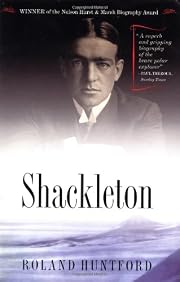
Roland Huntford: Shackleton: 2

Roland Huntford: Shackleton (Groot-Brittannië, 1985): 697 blz: Uitgeverij Hodder & Stoughton


Na zijn terugkeer van de "Farthest South" expeditie was Shackleton een held. Shackleton had nog niet genoeg van zijn poolreizen.
 
Shackleton wilde nog steeds de eerste man op de Zuidpool zijn. Na de succesvolle expeditie van de Noor Amundsen en de tragedie van de expeditie van kapitein Scott wilde Shackleton als eerste een oversteek dwars over Antarctica maken.
 
Hij had als schip de "Endurance". Net toen de eerste Wereldoorlog uitbrak voer Shackleton uit. Zijn schip strandde in het pakijs en zonk. Shackleton moest zichzelf en zijn manschappen in veiligheid zien te brengen. Met een enorm doorzettingsvermogen en dankzij een fantastisch leiderschap slaagde hij hier in. 
 
De overlevingstocht van Shackleton en zijn mannen is één van de meest indrukwekkende verhalen die ik ooit heb gelezen. Ik heb meerdere versies van dit verhaal gelezen, maar geen enkele is zo fascinerend en veelzijdig geschreven als in deze biografie van Huntford. 
 
Citaten:
- The real, largely unsung courage of Shackleton was that he had turned back. He was prepared to live with the might-have-been. "Only 97 miles off," as he expressed it to Elspeth Beardmore, "You can realise my feelings."
 To Emily, in her own words,
 The only comment he made to me about not reaching the Pole, was "a live donkey is better than a dead lion, isn't it?" and I said "Yes darling, as far as I am concerned," and we left it at that.
 
Shackleton over zijn beslissing om terug te keren:
- "Death lay ahead and food behind, so I had to return."
 
- From the expedition's birth, two tales have been handed down. ... The other tale is that Shackleton put this advertisement in the press:
 Men wanted for Hazardous Journey. Small wages, bitter cold, long months of complete darkness, constant danger, safe return doubtful. Honour and recognition in case of succes.

- Also ahead of his time in another field, Shackleton wanted dehydrated food to save weight on the march.

- On 11 december, Endurance again found the pack. This time it could not be turned. The ship was put straight in. Once more, Shackleton was in the half world, neither land nor sea, where ice floes, like giant gleaming shields, swarmed over grey waters. Once more, he saw seal and penguins spread over the ice, whales blowing in the leads, and strange Antarctic birds swooping overhead. To the ordinary ship's sounds of water-squelch, creak of timbers, thrum of rigging, squeak of halyards easing through tackle and the flap-flap of sails filling to the wind, was added the rasp of ice against wood and the throb of engines as steam was raised to pick a way ahead through zigzag channels.

- Since Nimrod Shackleton's feeling had grown that science on a expedition of his kind was regrettably necessary humbug.

- "To serve such a leader," Orde-Lees wrote as they were still sailing south, "is one of the greatest pleasures of the whole trip; he expects his orders to be literally & promptly obeyed but he knows one's linitations better than one does oneself ald he invariably allows for them, he never expects one to do more than one is capable of, he trusts one implicitly and he always appears to be pleased with what one has done."

- "It must have been a moment of bitter disappointment to Shackleton," wrote Macklin; "he had lost his ship, and with her any chance of crossing the Antarctic Continent,
 but he shewed it neither in word or manner. As always with him what had happened had happened: it ws in the past and he looked to the future ... without emotion, melodrama or excitement he said "ship and stores have gone - so now we'll go home.""

- "His first thought," Greenstreet said, "was for the men under him. He didn't care if he went without a shirt on his back so long as the men he was leading had sufficient clothing. He was a wonderful man that way; you felt that the party mattered more than anything else."

- He longed to leave the ice; yet he knew that, except to ships, the ice was at heart friendly. It gave food, shelter, drink, and something solid underfoot. It kept the waters calm. The open sea, which was the sole avenue of escape, he knew only too well, as a seaman, was ruthless, implacable and hostile.

- What Hurley and James had so unwillingly moved into, was a mixture of a hell-ship's fo'c'sle and some unsavoury slum. The penetration of snow-drift through cracks and crevices, though uncomfortable, was at least a whiff of cleansing. When that was finally stopped, the dirt and overcrowding were unrelieved. Rapidly, the most refine sense of smell adjusted to the blend of foetid, unventilated room, rancid blubber, bodies unwashed and clothes unchanged for six months, and guano slowly thawing underfoot to make up the distinctive aroma of the place.

- Only a chance gleam of light revelead that liquid from dirty drying socks, together with a stream from the nose of Green, the cook, was frequently discharging into the cooking pot.

- His narrow escapes on the Discovery and Nimrod expeditions had underlined for Shackleton how food, sleep and warmth were necessary for life. It was possible to survive without two, but not without all three. His only choice on the James Caird was to depend on food. He gave his men all they wanted to eat. There were two hot meals a day. With each he allowed nut food, a sledging biscuit each, and four lumps of sugar. In between meals, every four hours, he had a drink of hot dried milk served all round.


Reacties op dit blog zijn meer dan welkom.
 

Roland Huntford: Shackleton: 1

Roland Huntford: Shackleton (Groot-Brittannië, 1985): 697 blz: Uitgeverij Hodder & Stoughton


Roland Huntford heeft 3 prachtige biografieën geschreven over de waarschijnlijk vier beroemdste poolreizigers. In juni 2005 las ik achter elkaar "Nansen" (1997), "Scott and Amundsen" (1979) en "Shackleton" (1985). De biografie over Shackleton, die ik in 2021 deels heb herlezen (tot en met hoofdstuk 25 "March or die" en bladzijde 292) en nu heb uitgelezen, beschouw ik als de beste van deze 3 biografieën en tevens als mijn favoriete biografie die ik ooit heb gelezen.
 
Roland Huntford besteedt in deze biografie vooral aandacht aan waarom het gaat, de 3 grote poolreizen die Shackleton heeft gemaakt.

Ernest Shackeleton ging varen op relatief jonge leeftijd en had al jong de ambitie om beroemd te worden en vooral ook rijk. Op 13 september 1900 meldde Shackleton zich aan als vrijwilliger voor  de Zuidpoolexpeditie onder leiding van Robert Falcon Scott. 

Shackleton werd door Scott uitgekozen om samen met hem en de arts Edward Wilson te proberen om zover mogelijk naar het zuiden te reizen. Ze bereikten een Zuiderbreedte van iets meer dan 82 graden, hetgeen als niet erg indrukwekkend werd beschouwd. Shackleton werd ziek door scheurbuik en vreemd genoeg hebben ze daardoor waarschijnlijk hun leven gered, Scott dacht er niet over om terug te keren.

Na deze expeditie was Scott een held en Shackleton een nobody die ziek naar huis was gestuurd. Shackeleton zon op revanche en organiseerde een tweede Zuidpoolexpeditie met als enige doel om als eerste op de Zuidpool te zijn. Hij bereikte met zijn maten ruim 88 graden Zuiderbreedte en moest op 97 mijlen afstand van de Zuidpool omdraaien om nog de tocht te kunnen overleven. Het werd een race tegen de klok, maar met heel veel geluk redden ze het.

"Shackleton" is een prachtige biografie, mede doordat Huntford een enorme kennis heeft over de poolreizen en daarnaast beschikt over een soepele schrijfstijl en natuurlijk ook door het inspirerende levensverhaal van Shackleton. Om van deze biografie optimaal te kunnen genieten moet je Engels behoorlijk goed zijn.
 
Citaten:
- Shackleton left the dogs behind, and harnessed himself and his companions to the sledge instead. Turning themselves into beasts of burden, they laboured across the snow on their own unaided feet.
 It was a tableau that would have stupefied the eight other expeditions, of different nationalities, sharing the polar regions, north and south, with them. "Polar exploration without ski is extremely awkward," in the words of Otto Sverdup, the Norwegian explorer now entering his fourth consecutive year in the Arctic, "without dogs it is impossible." Only on Discovery were dogs and ski still considered doubtful innovations.

- The clash of personality has always been a danger more sinister than climate or terrain.

- The science of nutrition was then in its infancy. With hindsight, however, and also by the light of contemporary knowledge, the diet of these men battling their way south had too little protein and fat and too much carbohydrate for hard work at low temperatures. Since it was devoid of vitamin C, the reappearance of scurvy was only a matter of time; they themselves only knew that they carried with them the shadow of a mysterious disease.

- The British party, in contrast, had only the goal ahead, with nothing but physical strenght and dogged persistence and self-punishment to drive them on.
 All this, repeated for the next decade or so, has been romanticised as the "heroic age" of British polar exploration. Like much heroism, it was wasteful and unnecessary, and often only a cloak for incompetence. Shackleton and his companions had, in short, made things difficult for themselves.

- In after years Shackleton used to tell a story of hearing Wilson say to Scott he did not expect him to last the night. That made him determined, so he said, to pull through.

- Among polar explorers, Shackleton was the only one who openly promoted his expedition as a commercial venture. His aim was to be the first at the South Pole. Money would flow from telling the story in books, lectures, newspapers and the exciting innovation of the cinematograph.

- As Shackleton later rationalised it,
 The qualities ... necessary to the explorer are ... in ... order of importance: first, optimism; second, patience; third, physical endurance; fourth, idealism; fifth and last, courage ... Few men are wanting in courage but optimism nullifies disappointment and makes one more ready than ever to go on ... Impatience means disaster ... Physical endurance ... will not compensate for the first two moral or temperamental qualities.

Nadat Shackleton op 97 mijlen van de Zuidpool was omgedraaid:
- Even so, it had taken courage of a special kind to turn, after coming so far, and with the Pole almost within reach. It was arguably one of the bravest acts in the history of exploration. Any fool can go on blindly forward. It required insight and moral courage to turn back; especially when it meant publicly admitting defeat and to a despised rival. 

- They were living off pemmican and pony meat, with only four thin biscuits each a day now. Underlining every word, Wild wrote on the last day of January that Shackleton
 privately forced upon me his one breakfast biscuit, and would have given me another tonight had I allowed him. I do not suppose that anyone else in the world can thoroughly realise how much generosity and sympathy was shown by this; I DO by GOD I shall never forget it. Thousands of pounds would not have bought that one biscuit.

- One day, while Shackleton and Wild were sharing a tent, Shackleton suddenly asked Wild if he would return with him to make another attempt on the Pole. The situation was grotesque. They were at the extremity of starvation. It was so cold that, in his diary, Shackleton had been unable to write more than a sentence or two. They were in the middle of the Barrier, and survival was still no more than a chance. "This trip," as Wild had put it, when he was somewhere about 82 degrees S, in the throes of dysentery, "has completely cured me of any desire for more polar exploration." Nonetheless, in his own words, when Shackleton, shivering in his sleeping bag, asked him to come back,
 without any hesitation I replied "yes"! We then went on to discuss details. Shackleton was sure that he could raise sufficient funds in Australia to return (this) year.
 
Lees verder in mijn bespreking van het tweede deel van "Shackleton".


Reacties op dit blog zijn meer dan welkom.
 

zondag 9 mei 2021

Roland Huntford: Shackleton

Roland Huntford: Shackleton (Groot Brittannië, 1985): 697 blz: Uitgeverij Hodder & Stoughton
 
Shackleton by Roland Huntford
 
Roland Huntford heeft 3 prachtige biografieën geschreven over waarschijnlijk de vier beroemdste poolreizigers. In juni 2005 las ik achter elkaar "Nansen" (1997), "Scott and Amundsen" (1979) en "Shackleton" (1985). De biografie over Shackleton, die ik nu deels heb herlezen (tot en met hoofdstuk 25 "March or die" en bladzijde 292), beschouw ik als de beste van deze 3 biografieën en tevens als mijn favoriete biografie die ik ooit heb gelezen.
 
Roland Huntford besteed in deze biografie vooral aandacht aan waarom het gaat, de 3 grote poolreizen die Shackleton heeft gemaakt. Ik ben gestopt met herlezen nadat Shackleton en zijn mannen veilig teruggekomen zijn op hun schip na hun "Fartest South" expeditie. Er volgt nog een grote expeditie van 1914-1917 waarbij het schip van Shackleton "De Endurance" zonk en waarbij na een zeer moeizame overlevingstocht iedereen veilig naar Engeland wist terug te keren. Het verhaal van die tocht heb ik al meerdere keren gelezen en is zeer indrukwekkend.

Ernest Shackeleton ging varen op relatief jonge leeftijd en had al jong de ambitie om beroemd te worden en vooral ook rijk. Op 13 september 1900 meldde Shackleton zich aan als vrijwilliger voor  de Zuidpoolexpeditie onder leiding van Robert Falcon Scott. 

Shackleton werd door Scott uitgekozen om samen met hem en de arts Edward Wilson te proberen om zover mogelijk naar het zuiden te reizen. Ze bereikten een Zuiderbreedte van iets meer dan 82 graden, hetgeen als niet erg indrukwekkend werd beschouwd. Shackleton werd ziek door scheurbuik en vreemd genoeg hebben ze daardoor waarschijnlijk hun leven gered, Scott dacht er niet over om terug te keren.

Na deze expeditie was Scott een held en Shackleton een nobody die ziek naar huis was gestuurd. Shackeleton zon op revanche en organiseerde een tweede Zuidpoolexpeditie met als enige doel om als eerste op de Zuidpool te zijn. Hij bereikte met zijn maten ruim 88 graden Zuiderbreedte en moest op 97 mijlen afstand van de Zuidpool omdraaien om nog de tocht te kunnen overleven. Het werd een race tegen de klok, maar met heel veel geluk redden ze het.

"Shackleton" is een prachtige biografie, mede doordat Huntford een enorme kennis heeft over de poolreizen en daarnaast beschikt over een soepele schrijfstijl en natuurlijk ook door het inspirerende levensverhaal van Shackleton. Om van deze biografie optimaal te kunnen genieten moet je Engels behoorlijk goed zijn en je ook over voldoende tijd beschikken.
 
Citaten:
- Shackleton left the dogs behind, and harnessed himself and his companions to the sledge instead. Turning themselves into beasts of burden, they laboured across the snow on their own unaided feet.
 It was a tableau that would have stupefied the eight other expeditions, of different nationalities, sharing the polar regions, north and south, with them. "Polar exploration without ski is extremely awkward," in the words of Otto Sverdup, the Norwegian explorer now entering his fourth consecutive year in the Arctic, "without dogs it is impossible." Only on Discovery were dogs and ski still considered doubtful innovations.

- The clash of personality has always been a danger more sinister than climate or terrain.

- The science of nutrition was then in its infancy. With hindsight, however, and also by the light of contemporary knowledge, the diet of these men battling their way south had too little protein and fat and too much carbohydrate for hard work at low temperatures. Since it was devoid of vitamin C, the reappearance of scurvy was only a matter of time; they themselves only knew that they carried with them the shadow of a mysterious disease.

- The British party, in contrast, had only the goal ahead, with nothing but physical strenght and dogged persistence and self-punishment to drive them on.
 All this, repeated for the next decade or so, has been romanticised as the "heroic age" of British polar exploration. Like much heroism, it was wasteful and unnecessary, and often only a cloak for incompetence. Shackleton and his companions had, in short, made things difficult for themselves.

- In after years Shackleton used to tell a story of hearing Wilson say to Scott he did not expect him to last the night. That made him determined, so he said, to pull through.

- Among polar explorers, Shackleton was the only one who openly promoted his expedition as a commercial venture. His aim was to be the first at the South Pole. Money would flow from telling the story in books, lectures, newspapers and the exciting innovation of the cinematograph.

- As Shackleton later rationalised it,
 The qualities ... necessary to the explorer are ... in ... order of importance: first, optimism; second, patience; third, physical endurance; fourth, idealism; fifth and last, courage ... Few men are wanting in courage but optimism nullifies disappointment and makes one more ready than ever to go on ... Impatience means disaster ... Physical endurance ... will not compensate for the first two moral or temperamental qualities.

Nadat Shackleton op 97 mijlen van de Zuidpool was omgedraaid:
- Even so, it had taken courage of a special kind to turn, after coming so far, and with the Pole almost within reach. It was arguably one of the bravest acts in the history of exploration. Any fool can go on blindly forward. It required insight and moral courage to turn back; especially when it meant publicly admitting defeat and to a despised rival. 

- They were living off pemmican and pony meat, with only four thin biscuits each a day now. Underlining every word, Wild wrote on the last day of January that Shackleton
 privately forced upon me his one breakfast biscuit, and would have given me another tonight had I allowed him. I do not suppose that anyone else in the world can thoroughly realise how much generosity and sympathy was shown by this; I DO by GOD I shall never forget it. Thousands of pounds would not have bought that one biscuit.

- One day, while Shackleton and Wild were sharing a tent, Shackleton suddenly asked Wild if he would return with him to make another attempt on the Pole. The situation was grotesque. They were at the extremity of starvation. It was so cold that, in his diary, Shackleton had been unable to write more than a sentence or two. They were in the middle of the Barrier, and survival was still no more than a chance. "This trip," as Wild had put it, when he was somewhere about 82 degrees S, in the throes of dysentery, "has completely cured me of any desire for more polar exploration." Nonetheless, in his own words, when Shackleton, shivering in his sleeping bag, asked him to come back,
 without any hesitation I replied "yes"! We then went on to discuss details. Shackleton was sure that he could raise sufficient funds in Australia to return (this) year.


Reacties op dit blog zijn meer dan welkom.


Bent u op zoek
naar een mooi boek
Kijk dan bij
Ardi Seij 

woensdag 6 maart 2019

70: Shackleton

Shackleton (Groot Brittannië, 2002): 204 minuten: Regisseur Charles Sturridge

Shackleton PosterDe volgende inhoud heb ik overgenomen van mijn boekbespreking van "Zuid", het meesterwerk dat Shackleton heeft geschreven na zijn tocht.

Net na het begin van de Eerste Wereldoorlog in augustus 1914 ging Shackleton op pad met 2 boten: met de Endurance onder leiding van hemzelf en met als kapitein Frank Worsley, en met de Aurora. Shackleton zelf zou met een groep Antarctica oversteken vanuit de Weddellzee, de andere groep van Aurora zou vanuit de Rosszee voedsel en brandstofdepots aanleggen tot aan de 83e breedtegraad om de oversteek mogelijk te maken.

Het liep anders. De depots werden met veel moeite uitgezet door de groep vanuit de Rosszee, maar de Endurance kwam vast te zitten in het ijs van de Weddellzee. De boot werd verlaten op 27 oktober 1915 en zonk uiteindelijk op 21 november.

Shackleton had er lang over na gedacht hoe hij de groep veilig terug naar huis zou brengen. Er werden 3 reddingsboten, de honden en een deel van de voedselvoorraden gered. Persoonlijk bezittingen werden bijna alle achtergelaten.

Gedurende enkele maanden zat het team vast op een grote ijsschots. Uiteindelijk voeren ze naar Elephant eiland. Daar bouwden ze een provisorische hut.

Terwijl het grootste deel van de groep daar achterbleef onder leiding van Frank Wild, ging Shackleton met Frank Worsley en 4 anderen in de James Caird (een van de 3 boten) op weg naar Zuid Georgië, zo'n 1000 km verderop. Na een zeer moeilijke bootreis landden ze uitgeput op Zuid Georgië en daar moesten ze nog een tocht maken over een indrukwekkende bergrug met gletsjers om in veiligheid te komen.

De televisieserie volgt het verhaal van het boek nauwgezet. In de eerste 2 uur van de film maken we de voorbereidingen mee die Shackleton treft om de expeditie mogelijk te maken tot het moment dat de Endurance wordt verlaten. Het boek is prachtig verfilmd met veel aandacht voor allerlei kleine details. Mooie natuurbeelden worden afgewisseld met beelden waarop de groepsleden als een eenheid aan het werk zijn. Wat mij betreft een absoluut meesterwerk!

De dubbeldvd die ik heb gezien is compleet met een biografie van Shackleton en een making of. In de making of vooral aandacht voor de problemen die men bij het filmen moest overwinnen.

Op IMDB krijgt "Shackleton" van 2.400 mensen een waardering van 7,7.


Reacties op dit blog zijn meer dan welkom.
 

zaterdag 25 februari 2017

Robert Falcon Scott: Scotts laatste expeditie

Robert Falcon Scott: Scotts laatste expeditie (Groot Brittannië, 1913): 168 blz: Vertaald door J.M.A.G. Hendriks (1987): Uitgeverij Hollandia

Scotts laatste expeditie"Scotts laatste expeditie" is een vertaling van twee boeken. Hoofdstuk 1 tot en met 25 is vertaald uit de Duitse uitgave Letzte fahrt (F.A. Brockhaus, Wiesbaden 1981). De tekst vanaf hoofdstuk 26 is een vertaling van de integrale tekst van de dagboeken van kapitein Scott, vanaf 19 janauri 1912.

Het boek bestaat uit de dagboekaantekeningen van Scott. Het moet meteen maar gezegd worden: Scott is geen groot dagboekschrijver, alle aantekeningen bestaan voornamelijk uit de afgelegde afstand, bereikte positie, de temperatuur en vermeldingen over kwetsuren aan het lichaam en het eten. Wel geeft het een goed beeld van de doorstane ontberingen.


Wat citaten:
- Wilson probeerde op het ijsveld enkele pinguïns te vangen. Hij ging languit op de grond liggen en begon te zingen, waarna de dieren snel naar hem toe waggelden; maar zodra hij ophield, maakten ze zich weer uit de voeten. Gezang oefent op deze dieren een zeer grote aantrekkingskracht uit; Meares heeft met zijn volle stem het meeste succes.

- Honger en angst zijn de enige drijfveren van een hond: een lege maag maakt hem razend. Aangetuigd zijn deze dieren meestal goede vrienden; ze lopen naast elkaar, schuren hun schouders tegen elkaar, de een stapt over de ander heen als hij wil gaan liggen, een vreedzaam tafereel. Maar zodra ze voer ruiken, is de rust voorbij; de ene hond wantrouwt de andere en het kleinste voorval is voldoende om elkaar tot bloedens toe te bijten.

- Ik haalde opgelucht adem toen ik, behalve onze twee tenten, nog een derde in het Noodkamp zag! Maar elk voorval van vandaag verbleekte bij de inhoud van de brief die Atkinson mij overhandigde: er stond in dat de Noor Amundsen, die ook een zuidpoolexpeditie ondernam, in de Walvisbaai zijn winterkwartier heeft betrokken! Die man doorkruist mijn plannen. Hij is 110 kilometer dichter bij de pool dan ik. Bovendien had ik nooit gedacht dat hij zoveel honden veilig naar de ijsbarrière kon brengen. Met de honden kan hij al vroeg in het voorjaar vertrekken; met pony's is dat onmogelijk. Hoe het ook zij: ik mag mij door Amundsens handelwijze niet van de wijs laten brengen en blijf bij mijn oorspronkelijke plan alsof ik niets van Amundsen wist. Gewoon doorgaan, zonder vrees of dralen!

- De temperatuur in de hut is natuurlijk laag, maar verder is het erg gezellig. Wij beschikken over een onbeperkte hoeveelheid scheepsbeschuit, tamelijk veel cacao, koffie en thee, en zout en suiker hebben wij ook voldoende. De robben bij het Praamstation moeten ons van vlees voorzien - scheepsbeschuit in robbenvet gebakken is zelfs heel lekker - en een kleine voorraad lekkernijen, zoals choclade, linzen, rozijnen, havermout, sardientjes en jam brengt enige afwisseling in het menu.

- Het koken voor vijf personen duurt overigens een half uur langer dan voor vier. Bij de samenstelling van deze groep heb ik daar helemaal niet bij stilgestaan.

Ik vind het verhaal van Scott's zuidpoolexpeditie beter beschreven door Cherry-Garrards "The worst journey in the world" en vooral in de dubbelbiografie van Scott en Amundsen van Roland Huntford: "The last place on earth"

Het boek gaat bij deze van mijn lijst met favoriete reisverhalen af.


dinsdag 14 februari 2017

Apsley Cherry-Garrard: The worst journey in the world

Apsley Cherry-Garrard: The worst journey in the world (Groot Brittannië, 1922): 700 blz: Uitgever Constable & Co

The Worst Journey in the World"The worst journey in the world" is het verhaal van de Zuidpoolexpeditie van kapitein Scott zoals verteld door een van de deelnemers eraan.

Het verhaal van de expeditie zal de meeste mensen in grote lijnen bekend zijn. Scott vertrok in 1910 met als bedoeling om de eerste man op de Zuidpool te zijn. Terwijl hij onderweg was naar het Zuidpoolgebied kwam er een bericht dat Amundsen met zijn poolschip "De Fram" ook naar de Zuidpool ging. Het werd dus een wedstrijd wie er als het eerste zou zijn.

Mede omdat Amundsen beter georganiseerd was won die de race. Toen Scott op de Zuidpool arriveerde waren de Noren hem voorgeweest. Scott en zijn metgezellen (Evans, Oates, Bowers en Wilson) kwamen om op de terugtocht.

"The worst journey" vertelt het verhaal van de zuidpooltocht, maar ook over de voorbereidingen, de bootreis naar het Zuidpoolgebied en de winterreis waarbij de auteur samen met Bowers en Wilson een moeizame tocht door de ijskoude winternacht maakt om een paar eieren van de keizerspinguin te bemachtigen.

Het exemplaar van dit boek dat ik heb gelezen bevat een lezenswaardige inleiding van Paul Theroux.

Zoals gebruikelijk weer een aantal citaten:

Paul Theroux over het boek:
- When people ask me (I get the question about twice a month), "What is your favorite travel book?" I nearly always name this book. It is about courage, misery, starvation, heroism, exploration, discovery and friendship. It vividly illustrates the demands of science and the rigours of travel. It is a record of the coldest darkest days that can be found on our planet. It is written beautifully but not obviously, with a subtle artistry. It recounts a diabolical ordeal.

- For sheer downright misery give me a hurricane, not too warm, the yard of a sailing ship, a wet sail and a bout of sea-sickness.

- Henceforward every night on camping each pony leader built a wall behind his pony while his pemmican was cooking, and came out after supper to finish this wall before he turned in to his sleeping-bag - no small thing when you consider that the warmth of your hours of rest depends largely upon getting into your bag immediately you have eaten your hoosh and cocoa.

- We had a baddish time, being very glad to get out of our shivering bags next morning. We began to suspect, as we knew only too well later, that the only good time of the twenty-four hours was breakfast, for then with reasonable luck we need not get into our sleeping-bags again for another seventeen hours.

- The worst job was to get into our bags: the second or equal worst was to lie in them for six hours: this third worst was to get the primus lighted and a meal on the way.

- The march showed that with their loads the speed of the different ponies varied to such an extent that individuals were soon separated by miles.

Scott over de tocht naar de Zuidpool:
- The Southern Journey involves the most important object of the Expedition ... One cannot afford to be blind to the situation: the scientific public, as well as the more general public, will gauge the result of the scientific work of the Expedition largely in accordance with the succes of failure of the main object. With succes all roads will be made easy, all work will receive its proper consideration. With failure even the most brilliant work may be neglected and forgotten, at least for a time.

Scott in zijn boodschap aan het publiek toen duidelijk was dat ze het niet zouden redden:
- I do not think human beings ever came through such a month as we have came through, and we should have got through in spite of the weather but for the sickening of a second compagnion, captain Oates, and a shortage of fuel in our depots for which I cannot account, and finally, but for the storm which has fallen on us within 11 miles of the depot at which we hoped to secure our final suplies.

Men heeft zich altijd afgevraagd waarom de expeditie van Scott faalde terwijl die van Amundsen op rolletjes liep. Volgens biograaf Roland Huntford (The last place on earth) kwam het doordat Amundsen alles beter gepland had en vooral ook doordat Amundsen honden gebruikte om de sleeën te trekken, terwijl ze zelf ernaast of erachter skieden en het team van Scott was afhankelijk van ponies en menselijke trekkracht.