Abbas: Allah O Akbar: A Journey Through Militant Islam (Iran, 1994): 315 blz: Uitgeverij Phaidon
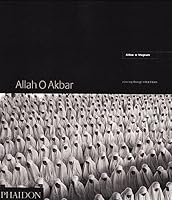
De Iraanse Magnum-fotograaf Abbas heeft
tussen eind 1986 en 1993, zeven jaar lang rondgereisd in een groot deel
van de islamitische wereld om onderzoek te doen naar de militante
stromingen in de moslimlanden.
Abbas
heeft hierbij gekozen voor een journalistieke aanpak waarbij de foto's
en de teksten elkaar versterken. De foto's geven voornamelijk een beeld
van het alledaagse leven. Er staan flink wat prachtige zwart-wit foto's
in "Allah O Akbar", maar zeker niet iedere foto in het boek is even
indrukwekkend.
Maar
wat het boek echt bijzonder maakt, is de hoge kwaliteit van de teksten van
Abbas. Ik schreef het al vaak, in de meeste kunst- en fotoboeken is de
kwaliteit van de teksten ver ondermaats. In "Allah O Akbar" zijn de
teksten vrij kort, maar zeer informatief en zeer inzichtgevend.
Ik
heb meerdere interessante boeken over de moslimwereld gelezen,
bijvoorbeeld: "De grote beschavingsoorlog" van Robert Fisk, "Onder de
gelovigen" en "Meer dan geloof" van V.S. Naipaul en "De koranroute" van
Rudi Rotthier. Ik vind dit boek van Abbas met zijn combinatie van
prachtige foto's en inzichtgevende teksten indrukwekkender dan elk van
die boeken.
Kortom,
"Allah O Akbar" is een fotoboek dat ik niet alleen iedere
fotoliefhebber, maar ook iedereen die geïnteresseerd is in de
moslimwereld zou willen aanraden!
Voor een idee van de foto's van Abbas, klik hier.
Citaten:
Egypte:
- What is left other than Islam and its political vision? The prevailing Islam is backward-looking, entrenched in the dogma of the past. No religious leader or politician would dare advocate birth control openly to at least halt Egypt's descent into poverty. Modern intellectuals are prisoners of dogma and traditions created for a nomadic or semi-nomadic society, whose population was decimated by war and disease.
Algerije:
- Ali Belhadj is the closed face of the FIS. He rouses the militants with simple slogans. His qotbahs,
the sermons which precede Friday prayer, declare: "Islam has no use for
democracy. To develop the economy, figures are irrelevant. Faith is
enough."
Afghanistan:
-
I had been mistaken in 1989 in Peshawar, when I had bet another
journalist who was very pro-mujahideen that the first measure they
would introduce on capturing Kabul would be to make women wear the hijab. That was the second measure.
Centraal Azië:
- " ... A great writer cannot content himself with the local language. He must write in a great language, and here that language is Russian."
- There is no sign of the usual symptoms of Islamist revival: bearded men and veiled women.
China:
- In Beijing, I was out of my depth. I could not decipher the Chinese "no": did it mean "maybe" if it was said with a smile? Did their "yes" mean "no way" if it was accompanied by an embarrassed laugh? In Sinkiang, a part of central Asia steeped in Turkish Muslim culture, I felt at home. Here, I understood everything.
Indonesië:
-
Islam has always evoked for me the dusty grey tones of the high
plateaux, the ochre of the sand dunes and scorched steppes, relieved by
the occasional green of an oasis. A desert religion of blue skies and
sweeping winds. In Indonesia, I discover a religion of water, forests
and of coconut palms, interwoven with the smooth geometry of the
terraced paddy fields. Islam is grafted on to ancient Buddhist, Hindu
and, above all, pagan beliefs.
Over Ibn Batuta:
- Before I left Paris, a friend advised me to take the Travels
of Ibn Batuta, that great fourteenth-century voyager who had travelled
to the Islamic lands several centuries before me. I immersed myself in
his account, deligthing in the prospect of discovering a fellow
traveller who would have had the same experiences, noted the same
differences, condemned the same extremism and known the same solitude.
How wrong I was! Ibn Batuta was no more than a traveller in search of
proof to support his convictions as to the greatness of Islam. He was
only interested in the Muslims, despising anybody else as kafirs - infidels, unbelievers. He was also a zealous qazi
who had a man whipped for drinking wine ... eight years previously. He
had people's hands cut off. A servile mind and a flatterer of the
Princes whose hospitality he always accepted.
And
what are we to think of all those women whom he married on his travels,
of those slaves who became his concubines? Happy times? Whereas I have
nothing but my cameras, my notebook and la Soledad - mi compañera de siempre.
Maleisië:
- " ... When a woman needs treatment, they bring me a tuft of her hair which I examine before prescribing a treatment." I was suddenly reminded of the legend of Ibn Sina who took his female patients' pulse with a piece of string while they sat behind a curtain. One day, some tricksters tied the string to a cat and he prescribed a diet of mice.
India:
- At Delhi airport I already had a foretaste of the tragedy affecting Kashmir. A young woman in T-shirt and jeans was sitting calmly among her brothers. When the flight for Sinagar was announced, she covered herself from head to foot in the black hijab. Her eyes gradually lost their sparkle. Her look became vacant. The young woman was preparing herself emotionally to confront the fears and fanaticism of Kashmir, as the Iranians do in western airports, on their return trip.
Pakistan:
- The General then decided to cross the enemy lines by road - he had to be at his HQ by morning - and invited me to go with him. Were my films worth such a risk? I told myself that a General did not take as many risks as a lieutenant and agreed to go with him. What I did not know, and one look at his face the next morning revealed this, was that I was dealing with one of those firebrand Generals, a "mad General", the sort who leads his troops into battle himself. Since then, I have never accepted an invitation from anyone whose face I could not see in the dark.
Groot-Brittannië:
- At the end, one of the leaders of the march, the one who has been protesting most vociferously against Salman Rushdie's right to express his views, accosts me to ask, with a note of urgency in his voice implying that the whole world is hanging on his every word: "Can you write my views in your newspaper?" Access to democracy demanded as an automatic right by those who refuse it to others.
Marokko:
- I have hired a car, and can stop where and when I like, no longer dependent on the vagaries of the bus or the train. The price for this freedom is that my inner journey, which involves reading Morocco's many novelists, is now less intense. The best way to get to know a country or place is always through its novelists.
Israël:
-
I am in Jerusalem as part of my reportage on Islam, and yet I have
photographed only Jews since my arrival. It is hard to avoid the Wailing
Wall and the daily spectacle it presents. Hassidim (orthodox Jews)
dressed in black, unkempt-looking with their shaven heads and beards,
are reminiscent of the fanatical Iranian mullahs. Aren't they all Ahl-al-Kitab,
"People of the Book", an expression which the Muslims reserve for
Christians and Jews to the exclusion of people from other religions?
Sarajewo:
-
The women of Sarajevo do not wear the hijab, or very rarely. They are
beautiful, haughty, and elegant, despite the constraints of the war. And
yet it is not the women that remind me that Sarajevo is a European
city, it is the dogs. In the cities of the Umma, the dogs are scrawny
and usually strays. Here, they are groomed and well fed while human
beings go hungry. At first I thought perhaps the people of Sarajevo were
fattening the dogs for the food shortages to come. But I soon realize
that the dogs are pets, pampered like children.