Roland Huntford: Shackleton (Groot Brittannië, 1985): 697 blz: Uitgeverij Hodder & Stoughton
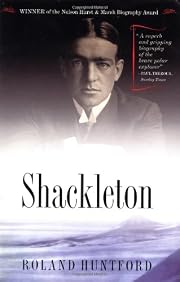
Roland Huntford heeft 3 prachtige biografieën geschreven over waarschijnlijk de vier beroemdste poolreizigers. In juni 2005 las ik achter elkaar "Nansen" (1997), "Scott and Amundsen" (1979) en "Shackleton" (1985). De biografie over Shackleton, die ik nu deels heb herlezen (tot en met hoofdstuk 25 "March or die" en bladzijde 292), beschouw ik als de beste van deze 3 biografieën en tevens als mijn favoriete biografie die ik ooit heb gelezen.
Roland Huntford besteed in deze biografie vooral aandacht aan waarom het gaat, de 3 grote poolreizen die Shackleton heeft gemaakt. Ik ben gestopt met herlezen nadat Shackleton en zijn mannen veilig teruggekomen zijn op hun schip na hun "Fartest South" expeditie. Er volgt nog een grote expeditie van 1914-1917 waarbij het schip van Shackleton "De Endurance" zonk en waarbij na een zeer moeizame overlevingstocht iedereen veilig naar Engeland wist terug te keren. Het verhaal van die tocht heb ik al meerdere keren gelezen en is zeer indrukwekkend.
Ernest Shackeleton ging varen op relatief jonge leeftijd en had al jong de ambitie om beroemd te worden en vooral ook rijk. Op 13 september 1900 meldde Shackleton zich aan als vrijwilliger voor de Zuidpoolexpeditie onder leiding van Robert Falcon Scott.
Shackleton werd door Scott uitgekozen om samen met hem en de arts Edward Wilson te proberen om zover mogelijk naar het zuiden te reizen. Ze bereikten een Zuiderbreedte van iets meer dan 82 graden, hetgeen als niet erg indrukwekkend werd beschouwd. Shackleton werd ziek door scheurbuik en vreemd genoeg hebben ze daardoor waarschijnlijk hun leven gered, Scott dacht er niet over om terug te keren.
Na deze expeditie was Scott een held en Shackleton een nobody die ziek naar huis was gestuurd. Shackeleton zon op revanche en organiseerde een tweede Zuidpoolexpeditie met als enige doel om als eerste op de Zuidpool te zijn. Hij bereikte met zijn maten ruim 88 graden Zuiderbreedte en moest op 97 mijlen afstand van de Zuidpool omdraaien om nog de tocht te kunnen overleven. Het werd een race tegen de klok, maar met heel veel geluk redden ze het.
"Shackleton" is een prachtige biografie, mede doordat Huntford een enorme kennis heeft over de poolreizen en daarnaast beschikt over een soepele schrijfstijl en natuurlijk ook door het inspirerende levensverhaal van Shackleton. Om van deze biografie optimaal te kunnen genieten moet je Engels behoorlijk goed zijn en je ook over voldoende tijd beschikken.
Citaten:
- Shackleton left the dogs behind, and harnessed himself and his companions to the sledge instead. Turning themselves into beasts of burden, they laboured across the snow on their own unaided feet.
It was a tableau that would have stupefied the eight other expeditions, of different nationalities, sharing the polar regions, north and south, with them. "Polar exploration without ski is extremely awkward," in the words of Otto Sverdup, the Norwegian explorer now entering his fourth consecutive year in the Arctic, "without dogs it is impossible." Only on Discovery were dogs and ski still considered doubtful innovations.
- The clash of personality has always been a danger more sinister than climate or terrain.
- The science of nutrition was then in its infancy. With hindsight, however, and also by the light of contemporary knowledge, the diet of these men battling their way south had too little protein and fat and too much carbohydrate for hard work at low temperatures. Since it was devoid of vitamin C, the reappearance of scurvy was only a matter of time; they themselves only knew that they carried with them the shadow of a mysterious disease.
- The British party, in contrast, had only the goal ahead, with nothing but physical strenght and dogged persistence and self-punishment to drive them on.
All this, repeated for the next decade or so, has been romanticised as the "heroic age" of British polar exploration. Like much heroism, it was wasteful and unnecessary, and often only a cloak for incompetence. Shackleton and his companions had, in short, made things difficult for themselves.
- In after years Shackleton used to tell a story of hearing Wilson say to Scott he did not expect him to last the night. That made him determined, so he said, to pull through.
- Among polar explorers, Shackleton was the only one who openly promoted his expedition as a commercial venture. His aim was to be the first at the South Pole. Money would flow from telling the story in books, lectures, newspapers and the exciting innovation of the cinematograph.
- As Shackleton later rationalised it,
The qualities ... necessary to the explorer are ... in ... order of importance: first, optimism; second, patience; third, physical endurance; fourth, idealism; fifth and last, courage ... Few men are wanting in courage but optimism nullifies disappointment and makes one more ready than ever to go on ... Impatience means disaster ... Physical endurance ... will not compensate for the first two moral or temperamental qualities.
Nadat Shackleton op 97 mijlen van de Zuidpool was omgedraaid:
- Even so, it had taken courage of a special kind to turn, after coming so far, and with the Pole almost within reach. It was arguably one of the bravest acts in the history of exploration. Any fool can go on blindly forward. It required insight and moral courage to turn back; especially when it meant publicly admitting defeat and to a despised rival.
- They were living off pemmican and pony meat, with only four thin biscuits each a day now. Underlining every word, Wild wrote on the last day of January that Shackleton
privately forced upon me his one breakfast biscuit, and would have given me another tonight had I allowed him. I do not suppose that anyone else in the world can thoroughly realise how much generosity and sympathy was shown by this; I DO by GOD I shall never forget it. Thousands of pounds would not have bought that one biscuit.
- One day, while Shackleton and Wild were sharing a tent, Shackleton suddenly asked Wild if he would return with him to make another attempt on the Pole. The situation was grotesque. They were at the extremity of starvation. It was so cold that, in his diary, Shackleton had been unable to write more than a sentence or two. They were in the middle of the Barrier, and survival was still no more than a chance. "This trip," as Wild had put it, when he was somewhere about 82 degrees S, in the throes of dysentery, "has completely cured me of any desire for more polar exploration." Nonetheless, in his own words, when Shackleton, shivering in his sleeping bag, asked him to come back,
without any hesitation I replied "yes"! We then went on to discuss details. Shackleton was sure that he could raise sufficient funds in Australia to return (this) year.
